Not All Parent Coaching Certifications Are Created Equal
Before You Choose a Parent/Family Coaching Certification, Ask These 7 Questions.
Download the free 7-question decision guide that helps you evaluate certifications through methodology, credibility, and long-term positioning.
You do not want to waste time on something generic.
You want a methodology that works:
when conflict is high,
when emotions are intense,
and when families are depending on you to lead.
That requires more than advice. It requires something proven.
Trusted by executives, public figures, and high-profile families.
Applied in private, in-home family intensives.
Parent Coaching Certifications Are NOT Created Equal
Your interested in parent/family coaching certification.
✓ Within minutes, you found dozens of options:
Weekend workshops.
Self-paced online courses.
Multi-month programs with impressive language and varying price points.
✓ On the surface, they may all look similar.
So how do you choose?
More importantly - How do you choose training that strengthens your professional identity instead of blending you into an already crowded space?
✓ Many certifications teach a variation of the same model:
Behavior management strategies.
Time-outs and reward systems.
Communication scripts.
Surface-level discipline tools
✓ There is nothing inherently wrong with those tools.
But tools alone do not create differentiation.
And they rarely prepare you for the complexity of real family systems - high-conflict co-parenting, escalated parent-teen dynamics, blended family tension, emotional shutdown, or chronic power struggles.
✓ When training stays at the level of tactics, you may find yourself:
Explaining strategies instead of transforming dynamics.
Coaching parents based only on their version of the story.
Working harder to prove your value in complex cases.
Struggling to clearly articulate what makes your work distinct.
✓ The issue is not effort. It is framework.
Without a structured methodology for decoding behavior, staying non-partisan, recalibrating leadership, and repairing relational ruptures, even experienced professionals can feel like they are improvising.
And improvisation does not build authority.
It builds fatigue.
WHY THIS MATTERS?
The certification you choose shapes:
• How you interpret behavior.
• How you intervene.
• How therapists refer to you.
• How confident you feel in complex family situations.
• And how families experience your leadership.
• Some training gives you techniques.
• Other training gives you a method.
There is a difference.

The 7 Questions That Clarify Your Decision
Choosing a parent coaching certification is not just about curriculum.
It is about alignment.
This free guide gives you a clear framework to evaluate any certification program - so you can choose training that strengthens your professional positioning, supports complex family work, and builds long-term authority.
Instead of comparing brochures, you will know exactly what to assess.
✓ Question 1: Methodology
What is the core approach to behavior?
Are you learning behavior management tools - or a structured method for decoding and understanding and recalibrating family dynamics?
✓ Question 2: Scope
Will you be trained to work with parents only - or with parents and children together?
Understanding the full system changes everything.
✓ Question 3: Foundation
Is the training based on recycled advice - or informed by research in nervous system regulation, attachment, and motivation?
✓ Question 4: Audience
Who is this certification designed for?
Are you joining a professional cohort - or a mixed community with varying levels of application?
✓ Question 5: Practice Structure
Does the program prepare you for session-based work only?
Or equip you with structured frameworks that support deeper, sustained transformation?
✓ Question 6: Credibility
Is the methodology clearly defined, protected, and built on years of application?
Or is it a generic label anyone can use?
✓ Question 7: Commitment
What level of depth, practice, and integration does the training require?
What This Means for You
By the end of this guide, you will:
• Understand the difference between tools and methodology
• Recognize what actually creates differentiation in this field
• Know how to evaluate credibility and professional standards
• Be able to articulate what kind of practitioner you want to become
• Make a confident, informed decision about your next step
Not based on hype. Not based on price.
Based on structure, depth, and long-term positioning.
STILL NOT SURE?
Frequently Asked Questions
Question 1: Is this guide promoting a specific certification?
The guide provides a structured framework for evaluating any parent coaching certification using seven critical questions. It includes examples from the Parent-Child Whisperer® Certification to illustrate how one program applies the framework, but the evaluation model can be used to assess any training you are considering.
Question 2: Who is this guide designed for?
This guide is intended for licensed therapists, certified coaches, educators, and mental health professionals who are exploring parent coaching certification.
Whether you are adding specialization to an existing practice or transitioning into family systems work, the guide helps you assess fit, structure, and professional alignment.
It is not designed for casual or hobby-level exploration.
Question 3: What happens after I download it?
You will receive the PDF immediately.
Over the following week, you may receive a few additional emails with deeper insight into the both-sides methodology and how professional-level certification differs from surface-level training.
You are free to review at your own pace. There is no pressure and no obligation.
If you would like to discuss certification further, you may schedule a consultation conversation.
Question 4: Is this therapy or clinical training?
No. The certification is professional coaching training informed by research in nervous system regulation, attachment, and motivation. It is not clinical licensure and does not replace therapeutic credentials.
This protects you legally and builds trust with therapists.
About the Parent-Child Whisperer® Method
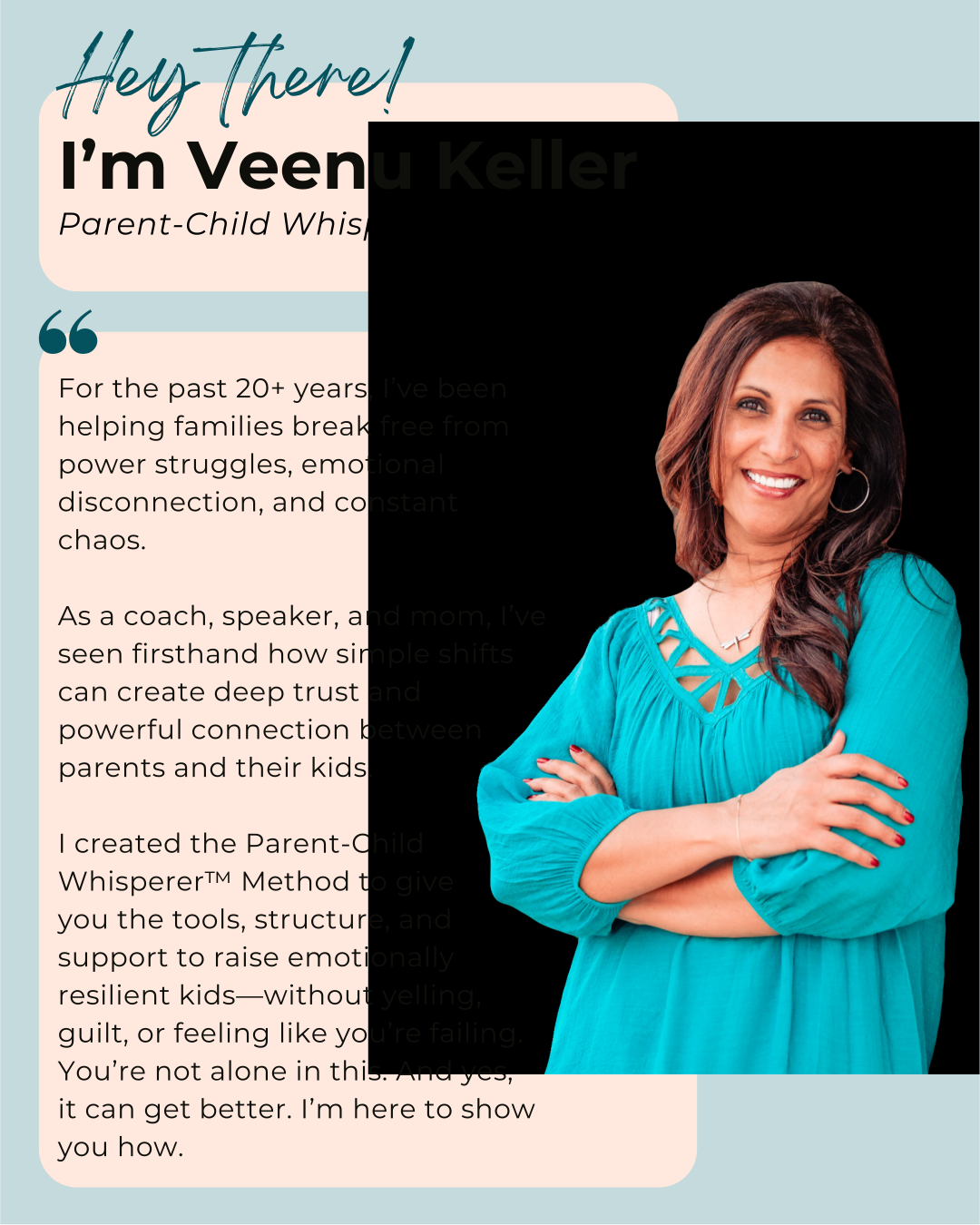
The Parent-Child Whisperer® Method was developed by Veenu Keller and has been applied in complex family systems work for over 15 years.
The methodology is informed by research in nervous system regulation, attachment, and motivational psychology and is structured around a non-partisan, both-sides approach to family recalibration.
It has been used in private family intensives and high-complexity cases requiring discretion, structure, and leadership clarity.
Certification includes one year of practitioner support and integration.
Parent-Child Whisperer® is a defined and protected methodology created by Veenu Keller.
Founded in 2009, Veenu Inspires has provided professional-level training for coaches, therapists, and educators in a both-sides, non-partisan approach to family systems work.
The certification prepares practitioners to work with parents and children together using a structured, research-informed framework.
A growing national network of certified practitioners applies this methodology in private practice and professional settings.